SMPTE AG 18
Administrative Guideline

Metadata Registers Procedures

Approved: 2025-03-25

Copyright Β© 2025, Society of Motion Picture and Television Engineers. All rights reserved. No part of this material may be reproduced, by any means whatsoever, without the prior written permission of the Society of Motion Picture and Television Engineers.


Table of contentsπŸ”—

  1. Foreword
  2. Introduction
  3. 1 Scope
  4. 2 Conformance
  5. 3 Normative references
  6. 4 Terms and definitions
  7. 5 General
    1. 5.1 Relationship with the SMPTE Standards Operations Manual
    2. 5.2 Relationship with Metadata Register Structure Document
    3. 5.3 Metadata Register Sub Group
    4. 5.4 Metadata Register Structure Documents
    5. 5.5 Current Version Byte
  8. 6 Entry Management and Publication
    1. 6.1 Private-Use Entry(ies)
    2. 6.2 Public-Use Entry(ies)
    3. 6.3 SMPTE-Controlled Entry
  9. 7 Development and Publication of a Release
    1. 7.1 General
    2. 7.2 Initiation
    3. 7.3 Modification of a Release during Development
    4. 7.4 Release Project
    5. 7.5 Release Numbering
    6. 7.6 Publication
    7. 7.7 Amendment
  10. 8 Submission Process
    1. 8.1 General
    2. 8.2 Initiation
    3. 8.3 Initial_draft State
      1. 8.3.1 Actions
      2. 8.3.2 Transition to Draft state
      3. 8.3.3 Transition to Withdrawn state
    4. 8.4 Draft State
      1. 8.4.1 Actions
      2. 8.4.2 Transition to mature State
      3. 8.4.3 Transition to initial_draft State
      4. 8.4.4 Transition to Withdrawn State
    5. 8.5 Mature State
      1. 8.5.1 Transition to Accepted State
      2. 8.5.2 Transition to Initial_Draft State
      3. 8.5.3 Transition to Withdrawn State
    6. 8.6 Accepted State
    7. 8.7 Withdrawn State
      1. 8.7.1 Actions
      2. 8.7.2 Transition to Initial_Draft State
  11. Annex A Acceptance Criteria (normative) (Normative)
    1. A.1 General
    2. A.2 Common Criteria
      1. A.2.1 Contact Information
      2. A.2.2 Submission File Name
      3. A.2.3 Contents
      4. A.2.4 Unique UL
      5. A.2.5 Conformance with the Metadata Register Structure Document
      6. A.2.6 Consistency
      7. A.2.7 Single Controlling Organization
      8. A.2.8 Deletion
    3. A.3 Top-Level Class 13 or Class 14 Nodes
      1. A.3.1 Submitter
      2. A.3.2 Version Byte
    4. A.4 SMPTE-Controlled Entry(ies)
      1. A.4.1 Submitter
      2. A.4.2 Version Byte
      3. A.4.3 Defining Document
    5. A.5 Criteria for Public-Use Entry(ies)
      1. A.5.1 Submitter
      2. A.5.2 Defining Document
      3. A.5.3 Version Byte
  12. Annex B Examples (informative) (Normative)
    1. B.1 SMPTE Engineering Document as Defining Document
    2. B.2 SMPTE RDD as Defining Document
    3. B.3 SMPTE AG 03 Reference as Defining Document or Class 13/14 Top-Level Node Allocation
  13. Annex C Allocation and Transfer of Control of Public-Use Entry(ies) and Private-Use Entry(ies) (normative) (Normative)
    1. C.1 Allocation
    2. C.2 Transfer of Control
  14. Annex D Private-Use Entry(ies) under SMPTE Control (normative) (Normative)
  15. Annex E Public-Use Entry(ies) under SMPTE Control (normative) (Normative)
  16. Bibliography

ForewordπŸ”—

The Society of Motion Picture and Television Engineers (SMPTE) is an internationally-recognized standards developing organization. Headquartered and incorporated in the United States of America, SMPTE has members in over 80 countries on six continents. SMPTE’s Engineering Documents, including Standards, Recommended Practices, and Engineering Guidelines, are prepared by SMPTE’s Technology Committees. Participation in these Committees is open to all with a bona fide interest in their work. SMPTE cooperates closely with other standards-developing organizations, including ISO, IEC and ITU. SMPTE Engineering Documents are drafted in accordance with the rules given in its Standards Operations Manual.

For more information, please visit www.smpte.org.

This Standards Administrative Guideline forms an adjunct to the use and interpretation of the SMPTE Standards Operations Manual. In the event of a conflict, the Operations Manual shall prevail.

IntroductionπŸ”—

This clause is entirely informative and does not form an integral part of this Administrative Guideline.

This Administrative Guideline covers all classes of Entry(ies) defined across all Metadata Register Structure Documents specified by SMPTE, and specifies:

1 ScopeπŸ”—

This Administrative Guideline specifies maintenance and publication processes specific to the SMPTE Metadata Registers.

2 ConformanceπŸ”—

The following keywords have a specific meaning in the context of this document:

3 Normative referencesπŸ”—

The following documents are referred to in the text in such a way that some or all of their content constitutes requirements of this document. For dated references, only the edition cited applies. For undated references, the latest edition of the referenced document (including any amendments) applies.

4 Terms and definitionsπŸ”—

For the purposes of this document, the following terms and definitions apply:

4.1
Controlling Organization
Entity responsible for the creation, modification or deletion of an Entry.
4.2
Node
Entry that can contain other Entry(ies).
Note 1 to entry: A more detailed definition is provided in each Metadata Register Structure Document.
4.3
Entry
Combines one UL and multiple associated properties.
Note 1 to entry: A more detailed definition is provided in each Metadata Register Structure Document.
4.4
Defining Document
Document referenced in the Defining Document property of an Entry.
Note 1 to entry: A more detailed definition is provided in each Metadata Register Structure Document.
4.5
Metadata Register
Collection of Entry(ies) defined by a Metadata Register Structure Document.
4.6
Metadata Register Structure Document
SMPTE Engineering Document that defines a Metadata Register.
Note 1 to entry: The SMPTE Registration Authority website lists Metadata Register Structure Documents, as provided by 5.4.
4.7
Release
A SMPTE Standard, or a revision or amendment thereof, whose elements consists of one or more Metadata Registers to be published.
4.8
UL
SMPTE-administered Universal Label as specified in SMPTE ST 298 and constrained by SMPTE ST 336.

5 GeneralπŸ”—

5.1 Relationship with the SMPTE Standards Operations ManualπŸ”—

This Administrative Guideline expands on the SMPTE Standards Operations Manual, Subclause 5.2.5 as applied to Registers. In case of conflict with the SMPTE Standards Operations Manual and this document, the former prevails.

5.2 Relationship with Metadata Register Structure DocumentπŸ”—

This Administrative Guideline supersedes all procedural material specified in Metadata Register Structure Documents, in general, and those listed in Table 1, in particular.

Table 1 β€” Superseded Procedures and Criteria.
SMPTE ST 335 Clause 5 and Annex B
SMPTE ST 395 Clause 5 and Annex B
SMPTE ST 2003 Clause 5 and Annex B
SMPTE ST 400 Clause 5 and Annex B

5.3 Metadata Register Sub GroupπŸ”—

The Metadata Register Sub Group is the Sub Group (as defined in the SMPTE Standards Operations Manual) responsible for developing Releases, as established by TC 30MR.

5.4 Metadata Register Structure DocumentsπŸ”—

The SMPTE Registration Authority website shall include a list of references to all Metadata Register Structure Documents, as determined from time-to-time by TC 30MR.

5.5 Current Version ByteπŸ”—

The SMPTE Registration Authority website shall include the current value of the version byte (Current Version Byte) for each Metadata Register, as determined from time-to-time by TC 30MR.

6 Entry Management and PublicationπŸ”—

6.1 Private-Use Entry(ies)πŸ”—

A Private-Use Entry is an Entry belonging to a top-level Class 14 Node whose control has been delegated to an entity other than SMPTE according to Annex C.

NOTE 1 —⁠ The Controlling Organization of a Private-Use Entry can transfer control of the Entry back to SMPTE as specified in Annex C. Annex D lists Entry(ies) that were previously Private-Use Entry(ies), but are currently SMPTE-Controlled Entry(ies).

Private-Use Entry(ies) shall not be published by SMPTE. The Controlling Organization of a Private-Use Entry is however encouraged to maintain and publish it using a method consistent with those specified herein.

The management and publication of Private-Use Entry(ies) is the sole responsibility of the Controlling Organization.

NOTE 2 —⁠ Conformance of the UL of Private-Use Entry(ies) remains governed by SMPTE ST 298 and constrained by SMPTE ST 336.

6.2 Public-Use Entry(ies)πŸ”—

A Public-Use Entry is an Entry belonging to a top-level Class 13 Node whose control has been delegated to an entity other than SMPTE according to Annex C.

NOTE —⁠ The Controlling Organization of a Public-Use Entry can transfer control of the Entry back to SMPTE as specified in Annex C. Annex E lists Entry(ies) that were previously Public-Use Entry(ies), but are currently SMPTE-Controlled Entry(ies).

Public-Use Entry(ies) shall be published by SMPTE using the Release process specified in Clause 7.

Each Controlling Organization shall submit for publication all Public-Use Entry(ies) it defines.

6.3 SMPTE-Controlled EntryπŸ”—

A SMPTE-Controlled Entry is an Entry that is neither a Private-Use Entry nor a Public-Use Entry.

SMPTE-Controlled Entry(ies) shall be published by SMPTE using the Release process specified in Clause 7.

No SMPTE Engineering Document should be balloted to FCD until all Entry(ies) it defines have reached the "mature" state.

No SMPTE RDD should undergo committee ballot until all Entry(ies) it defines have reached the "mature" state.

No SMPTE Engineering Document or RDD should be published until all Entry(ies) it defines have reached the "accepted" state.

7 Development and Publication of a ReleaseπŸ”—

7.1 GeneralπŸ”—

A Release follows the development process for Engineering Documents, as specified in the SMPTE Standards Operations Manual.

The document number of the Release is assigned as provided in SMPTE AG 02.

NOTE —⁠ A Release typically includes Metadata Registers for all Metadata Register Structure Documents.

7.2 InitiationπŸ”—

A Release is initiated by creating a Working Draft consisting of all Entry(ies) whose Submission is in the "accepted" state at the time of initiation.

NOTE —⁠ As a result, only Entry(ies) that have undergone the Submission process are published.

A Release should be initiated twice every calendar year.

7.3 Modification of a Release during DevelopmentπŸ”—

No Entry should be added to a Release at or after Committee Draft stage.

Any correction to an Entry included in a Release shall be made through a Submission.

7.4 Release ProjectπŸ”—

There is one Project, as defined in the SMPTE Standards Operations Manual, for each Release.

The Project shall be assigned to the Metadata Register Sub Group.

To help distinguish between Releases, the Project should be given a distinctive name.

EXAMPLE: Project names of past Releases have included condiment names such as "catsup" and "brown sauce".

7.5 Release NumberingπŸ”—

A Release is numbered according to the Document Numbering requirements specified in SMPTE AG 02.

The Release document number shall include both Year of Issue and Month of Issue, since multiple Releases are planned in a given year.

7.6 PublicationπŸ”—

Upon publication, a Release shall be made publicly available at the SMPTE Registration Authority website.

7.7 AmendmentπŸ”—

The amendment of a Release should be reserved for correcting errors before the next Release.

EXAMPLE: Periodic Releases lessens the need for amendments.

8 Submission ProcessπŸ”—

8.1 GeneralπŸ”—

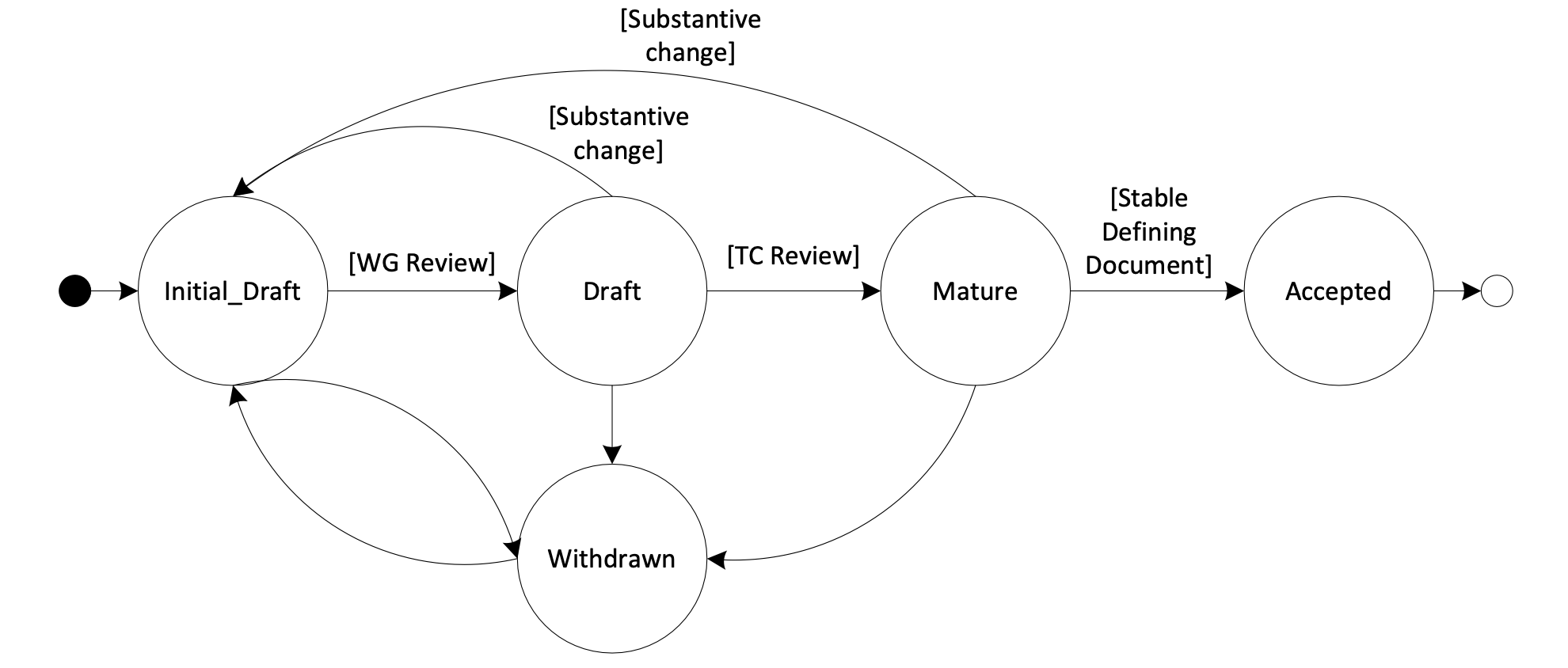
A Submission is a request to alter a Metadata Register. It follows the Submission process, which is specified in the following subclauses and illustrated in Figure 1, and is intended to prepare stable Entry(ies) for inclusion in a Release.

Annex B provides selected examples of the Submission process.

Figure 1 β€” Submission Process (informative).

The Metadata Register Sub Group shall make available to its parent Technology Committee all Submissions not incorporated in a Release. The Standards Vice President may, at his or her discretion, make the latter available publicly.

8.2 InitiationπŸ”—

A Submission achieves "initial_draft" state upon submission by a Submitter to the Metadata Register Sub Group.

The Submission shall meet the Acceptance Criteria specified in Annex A.

NOTE —⁠ Submitters are encouraged to work with the chair of the Metadata Register Sub Group prior to initiating a Submission to ensure that it meets the Acceptance Criteria.

8.3 Initial_draft StateπŸ”—

8.3.1 ActionsπŸ”—

The Submission shall be offered for review to the Metadata Register Sub Group.

The Submitter shall be responsible for addressing any deviation from the Acceptance Criteria noted by the Metadata Register Sub Group, and submitting a revised Submission.

NOTE —⁠ An "initial_draft" Submission is susceptible to significant substantive changes.

8.3.2 Transition to Draft stateπŸ”—

The Submission shall transition to the "draft" state if:

8.3.3 Transition to Withdrawn stateπŸ”—

The Submission shall transition to "withdrawn" if:

8.4 Draft StateπŸ”—

8.4.1 ActionsπŸ”—

The Submission shall be offered to the parent Technology Committee of the Metadata Register Sub Group for review.

NOTE 1 —⁠ A "draft" Submission remains susceptible to modifications following TC review.

NOTE 2 —⁠ The Technology Committee Chair determines the duration of the review, as needed to achieve the transition criteria of 8.4.2. This duration can be arbitrarily short if, for instance, the Submission was previously reviewed and changes are trivial.

8.4.2 Transition to mature StateπŸ”—

The Submission shall transition to the "mature" state unless the parent Technology Committee of the Metadata Register Sub Group has determined, by consensus, that the Submission fails to meet the Acceptance Criteria.

NOTE —⁠ Members that wish to provide comments beyond those related to the Acceptance Criteria are encouraged to join the group responsible for the Submission.

8.4.3 Transition to initial_draft StateπŸ”—

The Submission shall transition to "initial_draft" if any substantive modification is made to the Submission.

8.4.4 Transition to Withdrawn StateπŸ”—

The Submission shall transition to "withdrawn" if:

8.5 Mature StateπŸ”—

8.5.1 Transition to Accepted StateπŸ”—

The Submission shall transition to the "accepted" state once the Defining Document of all Entry(ies) whose Defining Document is an Engineering Document or a Registered Disclosure Document, if any, has passed ST Audit and matches the contents of the Entry exactly.

NOTE 1 —⁠ The "mature" state is provided if the Defining Document might undergo further modifications, but requires a stable Submission to proceed.

NOTE 2 —⁠ A "mature" Submission is modified if the Defining Document is modified.

A Submission that does not include Entry(ies) from a Defining Document that is an Engineering Document or a Registered Disclosure Document shall transition to the "accepted" state immediately.

8.5.2 Transition to Initial_Draft StateπŸ”—

The Submission shall transition to "initial_draft" if any substantive modification is made to the Submission.

8.5.3 Transition to Withdrawn StateπŸ”—

The Submission shall transition to "withdrawn" if:

8.6 Accepted StateπŸ”—

Modifications shall not be made to the Submission.

8.7 Withdrawn StateπŸ”—

8.7.1 ActionsπŸ”—

All ULs defined by the Submission shall become available to other Submissions.

8.7.2 Transition to Initial_Draft StateπŸ”—

The Submission may transition to "initial_draft" if requested by the Submitter.

Annex A
Acceptance Criteria (normative) (Normative)πŸ”—

A.1 GeneralπŸ”—

Submissions defining Public-Use Entry(ies) shall meet the criteria of Clause A.2 and Clause A.5.

Submissions defining top-level Class 13 or Class 14 Nodes shall meet the criteria of Clause A.2 and Clause A.3.

Submissions defining SMPTE-Controlled Entry(ies) other than top-level Class 13 or Class 14 Nodes shall meet the criteria of Clause A.2 and Clause A.4.

A.2 Common CriteriaπŸ”—

A.2.1 Contact InformationπŸ”—

The Submission shall include contact information for the Submitter.

A.2.2 Submission File NameπŸ”—

A Submission should consist of a single zip file.

The filename of the zip file should conform to the following FILENAME syntax

FILENAME := TC "-REG-" TYPE "-" DESCRIPTION "-" DATE
TC := 1*(ALPHA / DIGIT)
TYPE := "DD" / "CORR" / "CLASS13" / "CLASS14" / "MISC"
DATE := YYYY "-" MM "-" DD
YYYY := 4DIGIT
MM := 2DIGIT
DD := 2DIGIT

The TC field is the short name of the parent TC of the Metadata Register Sub Group, e.g. 30MR.

The TYPE field shall be selected based on the nature of the Submission as specified in Table A.1.

Table A.1 β€” Submission File Name Type Field.
TYPE Type of Submission
DD Addition of an Entry
CORR Correction to an existing Entry
CLASS13 Class 13 Node Allocation
CLASS14 Class 14 Node Allocation
MISC Other

NOTE —⁠ The MISC type is intended to be used if no other types fit, e.g. a Submission that both adds and corrects Entry(ies).

The DESCRIPTION field shall be selected based on the value of the TYPE field as specified in Table A.2.

Table A.2 β€” Submission File Name Description Field.
TYPE DESCRIPTION
DD Concise description of item(s) being added (e.g. ST2067-1)
CORR Concise description of item(s) being corrected (e.g. Groups-IsConcrete)
CLASS13 Description of Class13 Node owner and purpose of change (e.g. AVID-new-entries)
CLASS14 Description of Class14 Node owner and purpose of change (e.g. AVID-new-entries)
MISC Other

The DATE field shall be the date when the Submission was initially submitted.

EXAMPLE 1 —⁠ 30MR-REG-DD-ST2067-01-2017-12-10.zip

EXAMPLE 2 —⁠ 30MR-REG-CLASS13-LOC-new-entries-2017-10-10.zip

A.2.3 ContentsπŸ”—

A Submission shall consist of one or more documents, each containing Entry(ies) that belong to one Metadata Register.

Each XML document shall conform to one of the XML Schema definitions, which shall be determined by TC 30MR from time-to-time and published on the SMPTE Registration Authority website.

The filename of each document should conform to the following DOCNAME syntax:

DOCNAME := TC "-REG-" TYPE "-" DESCRIPTION "-" REGISTER
REGISTER := "groups" / "elements" / "labels" / "types" / "essence"

where the TC, TYPE and DESCRIPTION fields shall match that of the Submission file name (A.2.2).

EXAMPLE —⁠ 30MR-REG-DD-ST2067-01-groups.xml, 30MR-REG-CLASS14-XYZCorp-labels.xml

The filename of each document shall remain constant throughout the Submission process.

A.2.4 Unique ULπŸ”—

No UL added by the Submission shall be equal to any published or reserved UL.

This equality shall ignore the value of the version byte (byte 8).

A.2.5 Conformance with the Metadata Register Structure Document πŸ”—

Each Entry defined by the Submission shall conform to the corresponding Metadata Register Structure Document.

A.2.6 ConsistencyπŸ”—

Each Entry defined by the Submission should be consistent with other Entry(ies) within the same Node.

A.2.7 Single Controlling OrganizationπŸ”—

All Entry(ies) defined by the Submission shall belong to the same Controlling Organization.

A.2.8 DeletionπŸ”—

A Submission shall not result in an Entry being deleted.

NOTE —⁠ An Entry that is no longer appropriate is deprecated, i.e. its Deprecated field is set to "true".

A.3 Top-Level Class 13 or Class 14 NodesπŸ”—

A.3.1 SubmitterπŸ”—

The Submitter shall be the Director of Engineering.

A.3.2 Version ByteπŸ”—

The version byte (byte 8) of each new UL shall be Current Version Byte specified in 5.5.

A.4 SMPTE-Controlled Entry(ies)πŸ”—

A.4.1 SubmitterπŸ”—

The Submitter shall be a member of the Standards Community.

A.4.2 Version ByteπŸ”—

The version byte (byte 8) of each new UL shall be Current Version Byte specified in 5.5.

A.4.3 Defining DocumentπŸ”—

A Defining Document shall be associated with each Entry.

The Defining Document shall be either:

  • a SMPTE Engineering Document;
  • a specification listed in SMPTE AG 03; or
  • a SMPTE Registered Disclosure Document (RDD).

The Defining Document shall define the semantics of each Entry.

If the Defining Document is a SMPTE Engineering Document or a SMPTE Registered Disclosure Document, the Defining Document shall in addition define the associated properties of each Entry.

The Submission shall include a copy of the Defining Document, or the portion thereof sufficient to unambiguously define the semantics of the Entry.

A.5 Criteria for Public-Use Entry(ies)πŸ”—

A.5.1 SubmitterπŸ”—

The Submitter shall be the Controlling Organization of the Entry(ies) modified by the Submission.

A.5.2 Defining DocumentπŸ”—

A Defining Document should be associated with each Entry.

A.5.3 Version ByteπŸ”—

The version byte (byte 8) of each new UL added by the Submission is at the discretion of the Submitter.

Annex B
Examples (informative) (Normative)πŸ”—

B.1 SMPTE Engineering Document as Defining DocumentπŸ”—

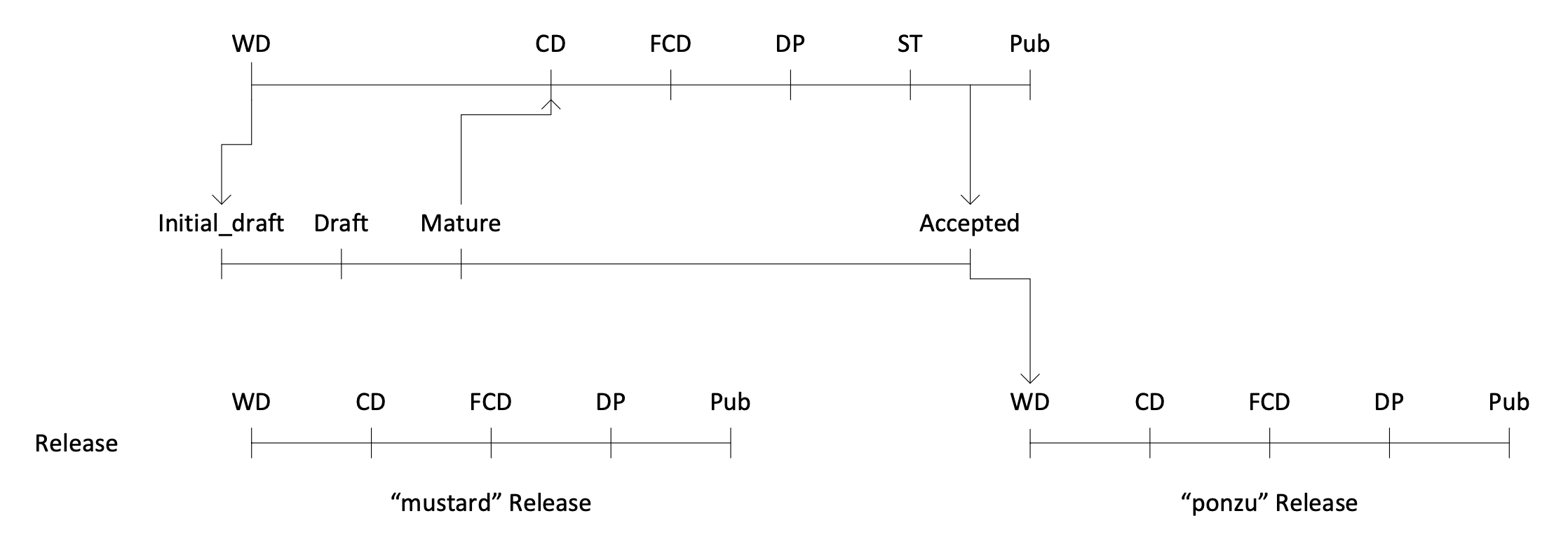
Figure B.1 illustrates the Release process for an Entry whose Defining Document is a SMPTE Engineering Document.

Figure B.1 β€” Sample Timeline: Entry whose Defining Document is a SMPTE Engineering Document.

B.2 SMPTE RDD as Defining DocumentπŸ”—

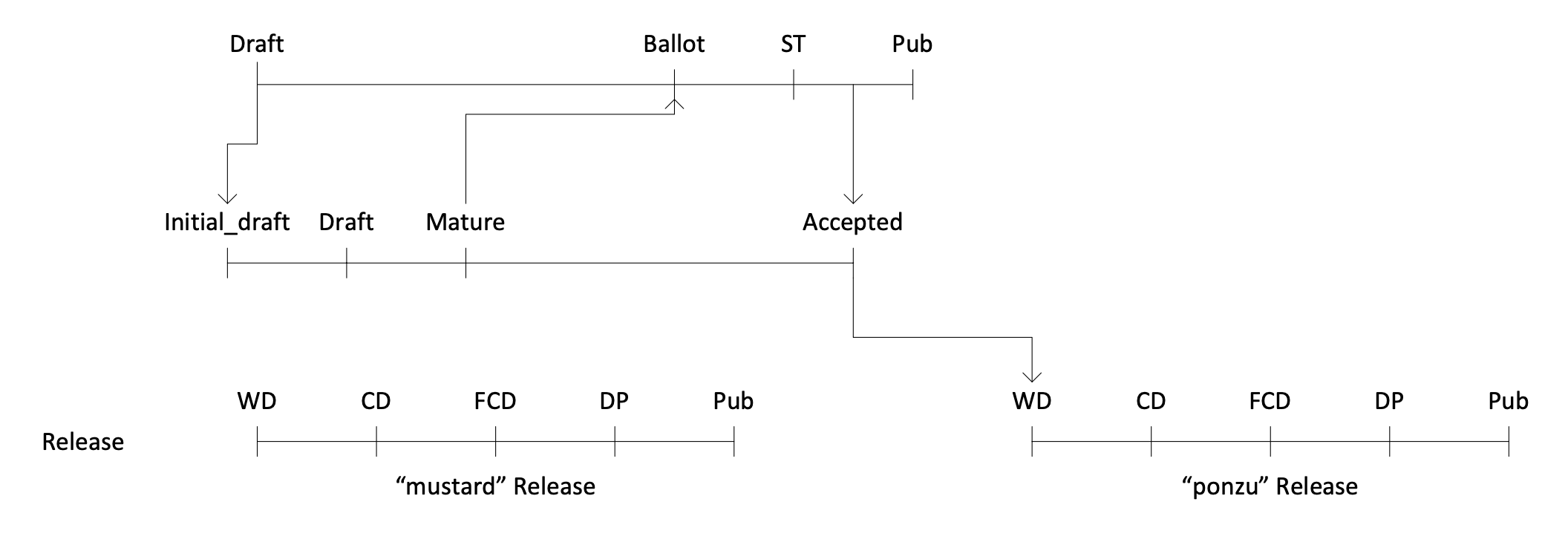
Figure B.2 illustrates the Release process for an Entry whose Defining Document is a SMPTE RDD.

Figure B.2 β€” Sample Timeline: Entry whose Defining Document is a SMPTE RDD.

B.3 SMPTE AG 03 Reference as Defining Document or Class 13/14 Top-Level Node Allocation πŸ”—

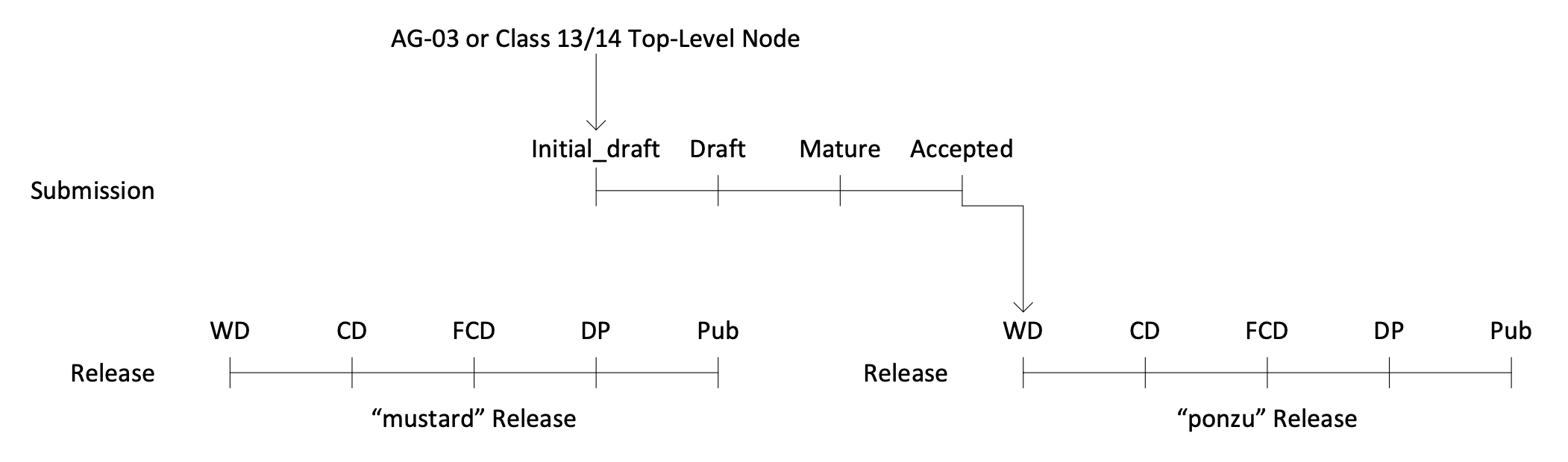
Figure B.3 illustrates the Release process for an Entry whose Defining Document references a normative reference permitted in SMPTE AG 03, or in the case of a Class 13/14 Top-Level Node Allocation (see Annex C).

Figure B.3 β€” Sample Timeline: Entry whose Defining Document is a SMPTE AG 03 or is a Class 13/14 Top-Level Node.

Annex C
Allocation and Transfer of Control of Public-Use Entry(ies) and Private-Use Entry(ies) (normative) (Normative)πŸ”—

C.1 AllocationπŸ”—

Any entity may request a top-level Class 13 or Class 14 Node from the Director of Engineering.

The request shall be in a form determined by the Director of Engineering and published on the SMPTE Registration Authority website, and may require a processing fee. The processing fee shall be determined from time-to-time by the Director of Engineering in consultation with the Standards Vice President and the Financial Vice President.

Upon receipt of the request and processing fee, the Director of Engineering shall initiate a Submission defining the Node being requested.

When the Submission achieves "draft" status, the entity becomes the Controlling Organization of all Entry(ies) within the Node, excluding the Node Entry itself, across all Metadata Register Structure Documents.

If the Submission is Withdrawn, the processing fee shall be returned to the requesting party.

C.2 Transfer of ControlπŸ”—

The Controlling Organization of a Private-Use Entry or a Public-Use Entry may, at its sole discretion, transfer control of the Entry to SMPTE at perpetuity.

The document stipulating the transfer of control shall be in a form determined by the Director of Engineering.

Annex D
Private-Use Entry(ies) under SMPTE Control (normative) (Normative)πŸ”—

The SMPTE Registration Authority website shall include a list of Private-Use Entry(ies) whose control has been delegated to SMPTE.

NOTE —⁠ A Private-Use Entry Controlled by SMPTE undergoes the same Submission process as any other SMPTE-Controlled Entry, and cannot be deleted and reused (see A.2.8).

Annex E
Public-Use Entry(ies) under SMPTE Control (normative) (Normative)πŸ”—

The SMPTE Registration Authority website shall include a list of Public-Use Entry(ies) whose control has been delegated to SMPTE.

NOTE —⁠ A Public-Use Entry Controlled by SMPTE undergoes the same Submission process as any other SMPTE-Controlled Entry, and cannot be deleted and reused (see A.2.8).

BibliographyπŸ”—