SMPTE
(the
The
Society
of
Motion
Picture
and
Television
Engineers)
Engineers
(SMPTE)
is
an
internationally-recognized
standards
developing
organization.
Headquartered
and
incorporated
in
the
United
States
of
America,
SMPTE
has
members
in
over
80
countries
on
six
continents.
SMPTE’s
Engineering
Documents,
including
Standards,
Recommended
Practices,
and
Engineering
Guidelines,
are
prepared
by
SMPTE’s
Technology
Committees.
Participation
in
these
Committees
is
open
to
all
with
a
bona
fide
interest
in
their
work.
SMPTE
cooperates
closely
with
other
standards-developing
organizations,
including
ISO,
IEC
and
ITU.
SMPTE
Engineering
Documents
are
drafted
in
accordance
with
the
rules
given
in
its
Standards
Operations
Manual.
For
more
information,
please
visit
www.smpte.org
.
This
Standards
Administrative
Guideline
forms
an
adjunct
to
the
use
and
interpretation
of
the
SMPTE
Standards
Operations
Manual.
In
the
event
of
a
conflict,
the
Operations
Manual
shall
prevail.
This
Administrative
Guideline
shows
in
flowcharts,
the
various
workflows
that
are
used
to
complete
work
items
(Projects)
in
the
Standards
Community
(SC).
Normative
text
is
text
that
describes
elements
of
the
design
that
are
indispensable
or
contains
the
conformance
language
keywords:
"shall",
"should",
or
"may".
Informative
text
is
text
that
is
potentially
helpful
to
the
user,
but
not
indispensable,
and
can
be
removed,
changed,
or
added
editorially
without
affecting
interoperability.
Informative
text
does
not
contain
any
conformance
keywords.
All
text
in
this
document
is,
by
default,
normative,
except:
the
Introduction,
any
section
explicitly
labeled
as
"Informative"
or
individual
paragraphs
that
start
with
"Note:"
The
following
keywords
"shall"
and
"shall
not"
indicate
requirements
strictly
to
be
followed
have
a
specific
meaning
in
order
to
conform
to
the
document
context
of
this
document:
shall
and
shall
not
express
a
requirement
from
which
no
deviation
is
permitted.
The
keywords,
"should"
permitted;
should
and
"should
not"
indicate
that,
among
several
possibilities,
one
is
recommended
as
particularly
suitable,
should
not
express
a
strong
recommendation
without
necessarily
mentioning
or
excluding
others;
or
that
a
certain
course
of
action
is
preferred
but
not
necessarily
required;
or
that
(in
the
negative
form)
a
certain
possibility
or
course
of
action
is
deprecated
but
not
prohibited.
The
keywords
"may"
other
choices;
may
expresses
explicit
liberty
(or
opportunity)
to
do
something;
Note
and
"need
not"
indicate
courses
of
action
permissible
within
the
limits
of
the
document.
The
keyword
"reserved"
informative
indicates
a
provision
that
the
associated
prose
is
not
defined
at
this
time,
shall
not
be
used,
and
may
be
defined
in
the
future.
The
keyword
"forbidden"
indicates
"reserved"
indispensable,
and
in
addition
indicates
that
the
provision
will
never
can
be
defined
in
the
future.
Unless
otherwise
specified,
the
order
of
precedence
of
removed,
changed,
or
added
editorially
without
affecting
the
types
of
normative
information
in
this
document
shall
be
as
follows:
Normative
prose
shall
be
scope,
or
the
authoritative
definition;
Tables
shall
be
next;
then
formal
languages;
then
figures;
and
then
any
other
language
forms.
document's
usage.
The
following
documents
are
referred
to
in
the
text
in
such
a
way
that
some
or
all
of
their
content
constitutes
requirements
of
this
document.
For
dated
references,
only
the
edition
cited
applies.
For
undated
references,
the
latest
edition
of
the
referenced
document
(including
any
amendments)
applies.
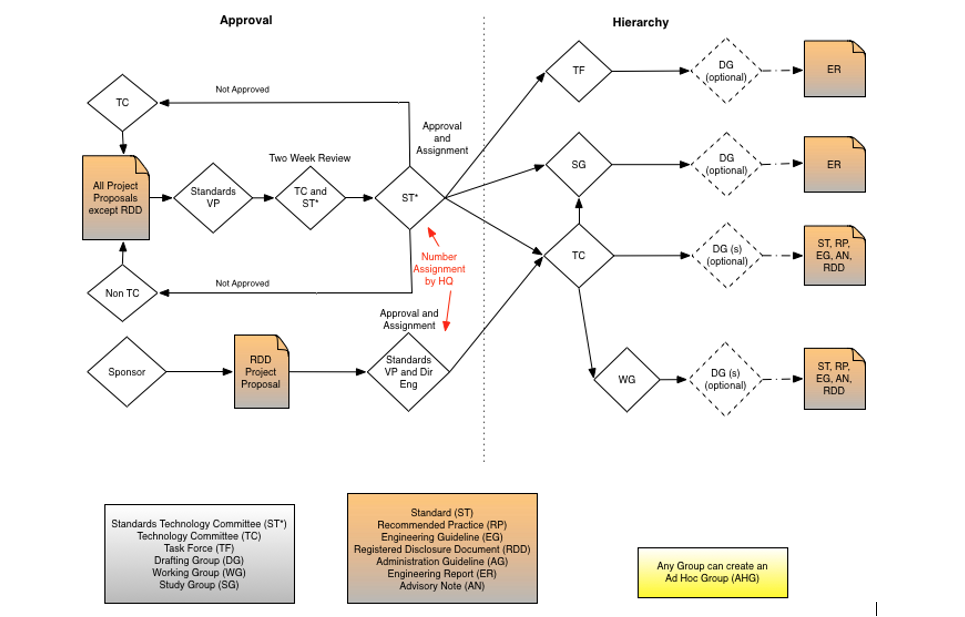
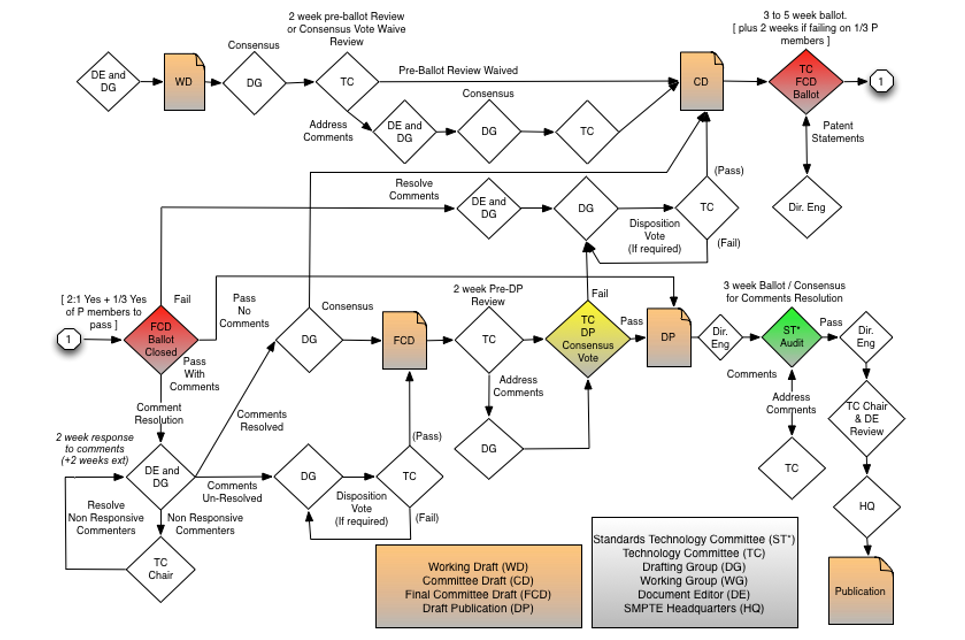
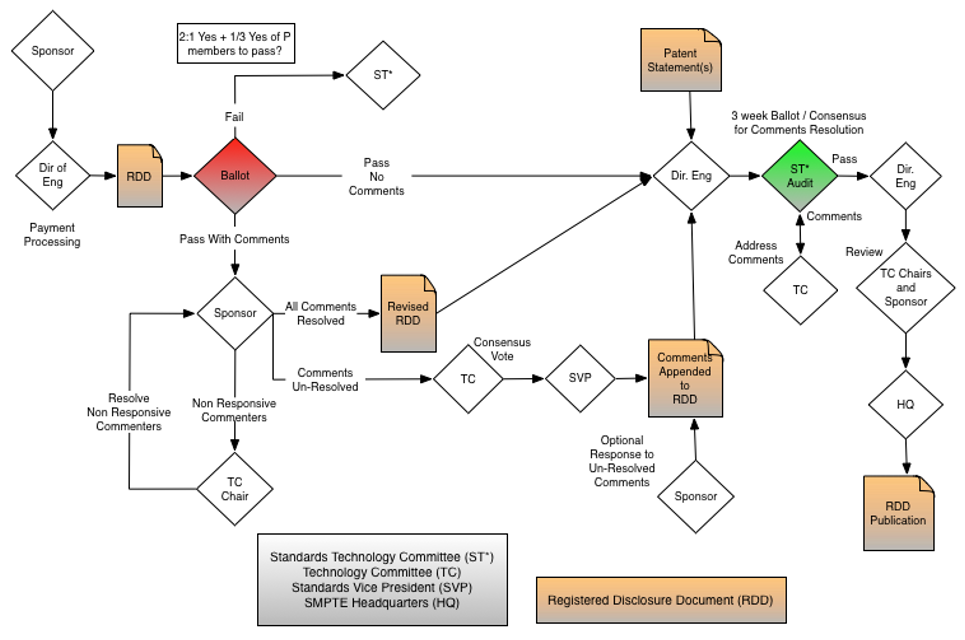
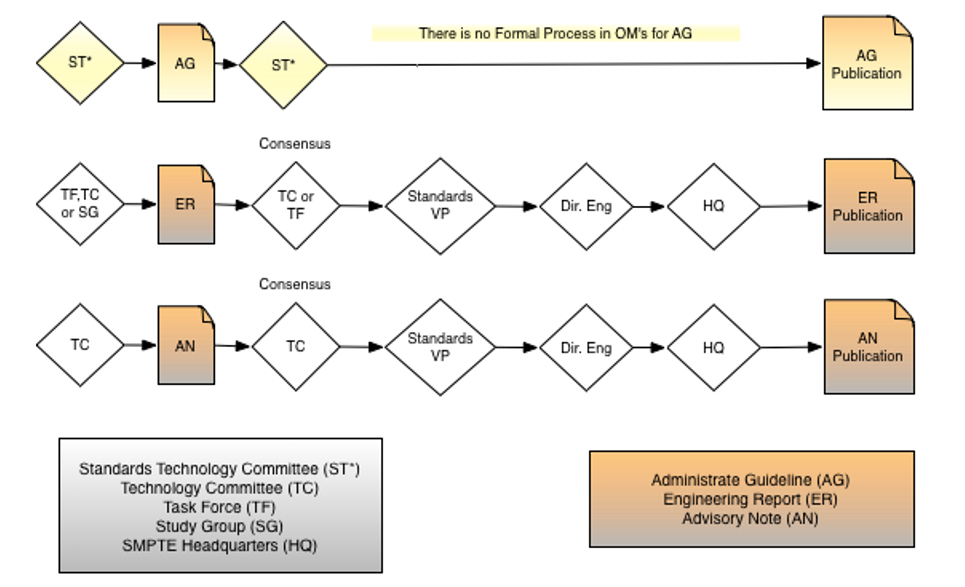
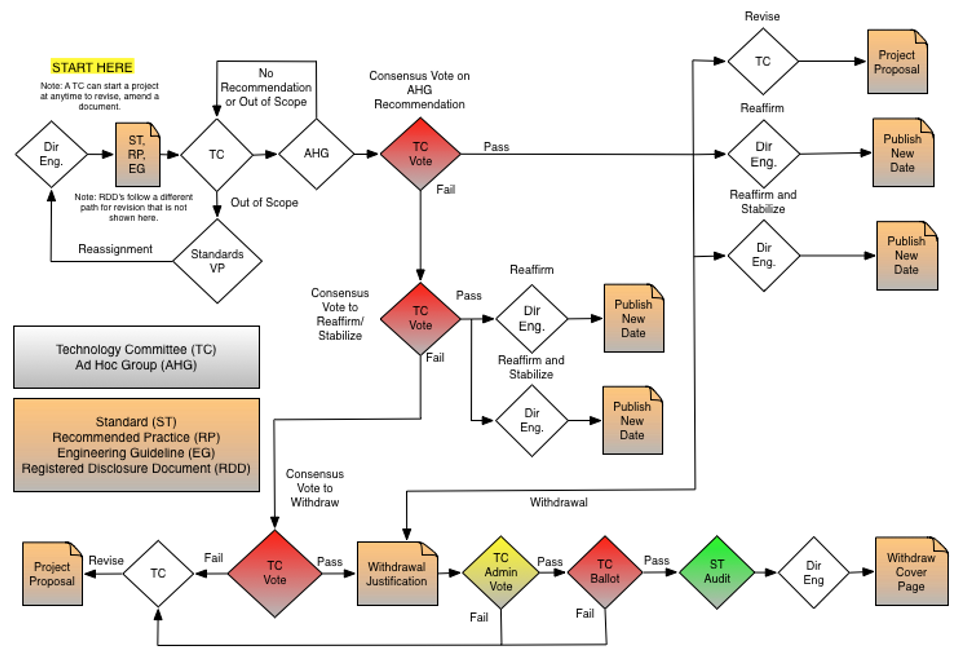
This
Administrative
Guideline
shows
in
flowcharts,
the
various
workflows
that
are
used
to
complete
work
items
(Projects)
in
the
Standards
Community
(SC).
Most
of
this
work
takes
place
at
the
Drafting
Group
(DG)
level
with
balloting
of
the
documents
at
the
Technical
Committee
(TC).
As
you
can
see
we
use
acronyms
to
abbreviate
names
to
save
space
on
the
Flowcharts.
Two
keys
are
given
on
each
flow
chart
to
expose
the
full
name
of
the
acronyms.
Figure
2
flowchart
shows
the
process
for
creating
Standards
(ST),
Recommended
Practices
(RP)
or
Engineering
Guidelines
(EG).
See
SMPTE
Standards
Operations
Manual
,
Sections
6.4
to
6.11.