Warning:
This
document
is
an
unpublished
work
under
development
and
shall
not
be
referred
to
as
a
SMPTE
Standard,
Recommended
Practice,
or
Engineering
Guideline.
It
is
distributed
for
review
and
comment;
distribution
does
not
constitute
publication.
Recipients
of
this
document
are
strongly
encouraged
to
submit,
with
their
comments,
notification
of
any
relevant
patent
rights
of
which
they
are
aware
and
to
provide
supporting
documentation.
SMPTE
(the
The
Society
of
Motion
Picture
and
Television
Engineers)
Engineers
(SMPTE)
is
an
internationally-recognized
standards
developing
organization.
Headquartered
and
incorporated
in
the
United
States
of
America,
SMPTE
has
members
in
over
80
countries
on
six
continents.
SMPTE’s
Engineering
Documents,
including
Standards,
Recommended
Practices,
and
Engineering
Guidelines,
are
prepared
by
SMPTE’s
Technology
Committees.
Participation
in
these
Committees
is
open
to
all
with
a
bona
fide
interest
in
their
work.
SMPTE
cooperates
closely
with
other
standards-developing
organizations,
including
ISO,
IEC
and
ITU.
SMPTE
Engineering
Documents
are
drafted
in
accordance
with
the
rules
given
in
its
Standards
Operations
Manual.
For
more
information,
please
visit
www.smpte.org
.
This
Standards
Administrative
Guideline
forms
an
adjunct
to
the
use
and
interpretation
of
the
SMPTE
Standards
Operations
Manual.
In
the
event
of
a
conflict,
the
Operations
Manual
shall
prevail.
This
Administrative
Guideline
defines
the
numbering
format
for
SMPTE
Engineering
Documents
and
specifies
the
permitted
file
formats
used
during
document
development
and
publication.
It
also
specifies
other
matters
relating
to
SMPTE
Engineering
Documents
with
regard
to
language,
style,
format,
document
type,
markups
required
at
various
stages
of
development,
etc.
Files
that
show
the
differences
between
two
versions
of
the
same
document
are
called
"markups"
in
this
Administrative
Guideline.
"Markup"
is
intended
to
cover
a
variety
of
terms
including:
"redline,"
"tracked
changes,"
"blackline,"
etc.
Normative
text
is
text
that
describes
elements
of
the
design
that
are
indispensable
or
contains
the
conformance
language
keywords:
"shall",
"should",
or
"may".
Informative
text
is
text
that
is
potentially
helpful
to
the
user,
but
not
indispensable,
and
can
be
removed,
changed,
or
added
editorially
without
affecting
interoperability.
Informative
text
does
not
contain
any
conformance
keywords.
All
text
in
this
document
is,
by
default,
normative,
except:
the
Introduction,
any
section
clause
explicitly
labeled
as
"Informative"
or
individual
paragraphs
that
start
with
"Note:"
The
keywords
"shall"
and
"shall
not"
indicate
requirements
strictly
to
be
followed
in
order
to
conform
to
the
document
and
from
which
no
deviation
is
permitted.
The
keywords,
"should"
and
"should
not"
indicate
that,
among
several
possibilities,
one
is
recommended
as
particularly
suitable,
without
mentioning
or
excluding
others;
or
that
a
certain
course
of
action
is
preferred
but
not
necessarily
required;
or
that
(in
the
negative
form)
a
certain
possibility
or
course
of
action
is
deprecated
but
not
prohibited.
The
keywords
"may"
and
"need
not"
indicate
courses
of
action
permissible
within
the
limits
of
the
document.
The
keyword
"reserved"
indicates
a
provision
that
is
not
defined
at
this
time,
shall
not
be
used,
and
may
be
defined
in
the
future.
The
keyword
"forbidden"
indicates
"reserved"
and
in
addition
indicates
that
the
provision
will
never
be
defined
in
the
future.
Unless
otherwise
specified,
the
order
of
precedence
of
the
types
of
normative
information
in
this
document
shall
be
as
follows:
Normative
prose
shall
be
the
authoritative
definition;
Tables
tables
shall
be
next;
then
formal
languages;
then
figures;
and
then
any
other
language
forms.
The
following
documents
are
referred
to
in
the
text
in
such
a
way
that
some
or
all
of
their
content
constitutes
requirements
of
this
document.
For
dated
references,
only
the
edition
cited
applies.
For
undated
references,
the
latest
edition
of
the
referenced
document
(including
any
amendments)
applies.
All
SMPTE
Engineering
documents
shall
be
written
in
U.
S.
English.
Translations
into
other
languages
by
SMPTE
(or
by
3rd
parties
authorized
by
SMPTE)
are
encouraged
but
not
required.
In
the
event
of
discrepancy,
the
original
English
language
document
shall
be
authoritative.
All
Engineering
Documents
should
follow
the
guidelines
of
the
ISO/IEC
Directives,
Part
2
with
the
following
exceptions:
In
the
event
of
a
conflict,
explicit
provisions
of
SMPTE
Standards
Operations
Manual
and
Administrative
Guidelines
shall
prevail.
Any
variances
from
the
ISO/IEC
Directives,
Part
2
shall
be
approved
by
the
Director
of
Engineering
or
the
Standards
Vice
President.
Prior
to
being
submitted
for
pre-FCD
ballot
review,
draft
Engineering
Documents
may
use
other
editing
formats,
as
selected
by
the
Standards
Community
document
repository.
Project
Group.
A
revision
of
an
An
Engineering
Document
may
use
the
original
template
if
be
revised
in
its
existing
format,
with
the
resulting
prose
is
identical
to
that
resulting
from
use
explicit
permission
of
the
current
template
and
the
Standards
Vice
President
or
Director
of
Engineering
agree
to
the
use
of
the
original
publication
template.
Engineering.
For
a
revision
of
an
Engineering
Document,
the
Project
Group
should
start
with
the
Publication
Master,
which
usually
can
be
obtained
from
SMPTE
HQ.
The
Project
Group
may,
at
its
discretion,
recreate
the
original
document,
as
published,
if
an
editable
master
cannot
be
found.
The
Project
Group
is
encouraged
to
follow
the
ISO/IEC
Directives,
Part
2
but
is
under
no
obligation
to
do
so.
SMPTE
Engineering
Documents
may
be
published
on
paper
or
in
various
electronic
formats
and
may
comprise
one
or
more
separate
elements.
An
Engineering
Document
always
shall
include
a
single
prose
element
and
may
include
other
elements
such
as
XML,
spreadsheets,
media
files,
and
so
forth.
The
collection
of
elements,
regardless
of
formats
employed,
is
the
"Engineering
Document"
as
a
whole,
and
all
elements
shall
be
clearly
identified
in
the
prose
element
(see
10.4
).
Any
change
to
any
element
constitutes
a
change
to
the
Engineering
Document.
The
Project
Group
and
the
Technology
Committee
shall
determine
the
number
of
elements
for
publication.
The
Director
of
Engineering
shall
determine
the
distribution
media
for
all
published
documents.
The
format
of
publication
shall
alter
neither
the
relevance
of,
nor
the
processes
that
otherwise
are
required
for
approval
of,
an
Engineering
Document.
Engineering
Document
Elements
may
be
packaged
as
one
or
more
Elements
using
ZIP
to
facilitate
the
organization
and
distribution
of
the
component
files.
Engineering
Documents
and
other
contributed
documents
With
the
exception
figures,
the
main
element
shall
be
submitted
to
a
Technology
Committee
or
its
subgroups
in
as
a
limited
set
of
file
formats.
The
following
formats
are
approved:
Prose
and
Embedded
Tables:
doc
and
.docx
single
HTML
document,
as
specified
at
SMPTE
HTML
Publication
Workflow
.
Engineering
Documents
should
use
Office
2007
formats
(.docx)
for
Prose
and
tabular
documents.
Engineering
Documents
may
use
Office
2003
formats
(.doc)
as
needed.
The
Project
Group
Images
referenced
in
the
main
element
shall
determine
which
format
to
use
on
a
project-by-project
basis.
Conversions
between
Office
2003
and
Office
2007
formats
are
not
perfect.
To
minimize
the
risk
one
of
unintended
artifacts,
conversion
between
formats
is
not
required.
Adobe
Acrobat
(.pdf)
Adobe
Acrobat
files
may
be
contributed
but
shall
be
accompanied
by
editable
files
for
all
the
elements
in
the
document
(prose,
tables,
drawings,
etc.)
to
permit
further
revision.
Spreadsheet:
.xls
and
.xlsx
following
formats:
The
Project
Group
An
editable
master
shall
decide
which
spreadsheet
format
(.xls
or
.xlsx)
to
use
be
provided
for
each
project.
The
preferred
format
is
.xlsx.
XML
Any
document
conforming
to
W3C
XML
1.0
may
be
submitted.
The
namespaces
of
all
normative
XML
elements
used
image
in
XML
documents
shall
have
a
corresponding
normative
reference
in
the
prose.
format
other
than
image/svg+xml
.
The
file
extension
editable
master
shall
be
".xml",
unless
otherwise
specified
by
the
defining
specification
in
one
of
the
document
or
by
an
appropriate
IANA
media
type
registration.
Documents
conforming
to
the
following
XML-based
specifications
are
specifically
allowed:
formats:
W3C
XML
Schema
Part
1:
Structures
Second
Edition
application/vnd.openxmlformats-officedocument.wordprocessingml.document
as
specified
at
IANA
Media
Types
(file
extension:
.xsd)
W3C
Web
Services
Description
Language
(WSDL)
1.1
application/vnd.openxmlformats-officedocument.presentationml.presentation
,
as
specified
at
IANA
Media
Types
For
new
projects
.jpg,
.jpeg,
.png,
.tif
and
.tiff
are
approved
image
formats.
Revisions
of
existing
documents
Additional
elements
may
continue
to
use
.bmp.
Media
files:
Any
audio,
video
or
image
media
format
documented
by
SMPTE,
whether
be
provided
in
an
Engineering
Document
or
an
RDD,
or
any
other
media
format
that
is
commonly
used,
widely
available,
specified
in
a
Permitted
Normative
References,
as
defined
in
SMPTE
AG-03
,
and
appropriate
for
the
user
community
for
which
the
Engineering
Document
has
been
created.
a
media
type
exists,
as
specified
at
IANA
Media
Types
.
Other
non-prose
elements:
.txt
and
program
source
formats
The
file
name
extension
for
each
additional
element
shall
conform
to
the
convention
specified
at
IANA
Media
Types
.
The
Director
of
Engineering
shall
store
and
process
documents
in
the
format
chosen
by
a
Project
Group
and/or
Technology
Committee.
The
Director
of
Engineering
shall
ensure
that
copies
of
the
editable
source
documents
are
maintained
for
all
published
Engineering
Documents.
The
editable
publication
master
should
be
made
available
by
the
Director
of
Engineering
when
a
Revision
or
Amendment
project
is
started.
Normative
information
in
a
SMPTE
Engineering
Document
may
take
the
language
form
of
prose,
tables,
figures,
formal
languages
(e.g.,
mathematical
formulae,
BNF,
XML,
pseudo
code),
and
other
language
forms.
Mathematical
formulae
shall
follow
the
definitions
documented
in
ISO
80000-2
when
possible.
When
ISO
80000-2
is
not
sufficient
(e.g.,
BNF,
XML
Schema,
etc.),
a
Normative
Reference
for
the
mathematical
definitions
used
shall
be
provided.
Such
Normative
Reference
shall
comply
with
the
provisions
of
the
SMPTE
Standards
Operations
Manual
and
SMPTE
AG-03
.
When
language
forms
other
than
prose
are
present,
the
prose
shall
state
whether
the
language
is
normative
or
informative.
Normative
provisions
shall
be
enabled
explicitly
(e.g.,
"The
dimensions
of
figure
1
shall
be
used.").
The
presence
of
non-prose
information
without
prose
conformance
language
shall
be
deemed
informative.
Document
numbers
shall
be
unique
and
uniform
across
all
Engineering
Document
types.
Versions
of
documents
shall
be
identified
by
their
the
year
of
publication
and,
optionally,
their
and
month
of
publication,
their
approval
date,
appended
with
a
separating
colon
(e.g.,
for
document
#1020:
1020:2009
or

1020:2009-04
,
the
latter
indicating
publication
approval
in
April,
2009).
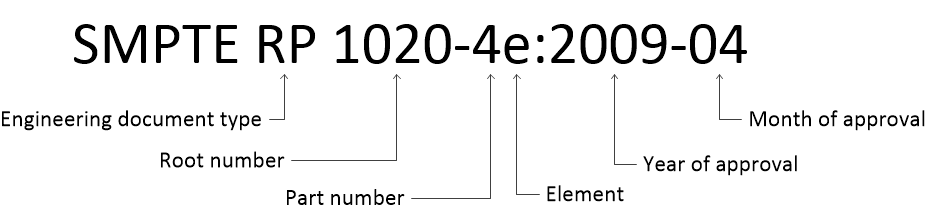
Figure
1
shows
an
example
of
the
document
numbering
structure.
The
approval
date
of
a
document
indicates
when
it
was
last
approved
by
its
consensus
body,
e.g.,
Technical
Committee.
The
Director
of
Engineering
shall
assign
document
numbers
(or
root
document
numbers,
in
the
case
of
multipart
documents).
Document
numbers
may
be
assigned
at
the
request
of
the
Technology
Committee
Chair(s)
at
any
time
after
a
Project
is
approved
and
shall
be
assigned
before
a
Final
Committee
Draft
ballot
is
issued.
Older
Engineering
Documents
may
bear
one-,
two-,
or
three-digit
document
numbers
or
root
document
numbers.
These
numbers
shall
not
be
prepended
with
leading
zeroes
when
formatted
for
printing,
either
in
the
document
itself
or
in
citations
in
other
documents.
Such
document
numbers
shall
be
prepended
with
leading
zeroes
to
fill
them
out
to
four
digits,
however,
when
used
as
part
of
an
element’s
filename;
the
purpose
is
to
facilitate
sorting
into
numerical
order.
The
Type
of
Engineering
Document
(Standard,
Recommended
Practice
or
Engineering
Guideline)
shall
be
denoted
by
prepending
a
Type
Designator,
followed
by
a
single
space,
to
the
document’s
root
number.
The
Type
Designator
shall
be
as
follows:
ST
Standard
RP
Recommended
Practice
EG
Engineering
Guideline
Although
they
are
not
Engineering
Documents,
Registered
Disclosure
Documents,
Advisory
Notes,
Administrative
Guidelines,
and
Engineering
Reports
shall
bear
Type
Designators
as
follows:
RDD
Registered
Disclosure
Document
AN
Advisory
Note
AG
Administrative
Guideline
ER
Engineering
Report
OV
Overview
Document
(Part
0
document)
RDDs
and
ERs
shall
be
numbered
using
independent
number
spaces.
The
numbers
shall
be
assigned
by
SMPTE
Headquarters
staff.
Closely
related
Engineering
Documents
may
be
created
as
Parts.
A
Part
of
a
document
is
a
separate
Engineering
Document
and
shall
be
shown
to
be
related
to
other
by
using
the
same
root
document
number
plus
a
suffix
of
a
hyphen
and
the
Part
number
to
distinguish
among
Parts
(e.g.
1020-2:2009

1020-2:2009-04
,
indicating
document
1020,
Part
2).
A
multipart
set
of
documents
may
include
Parts
of
different
types
of
Engineering
Documents,
including
Standards,
Recommended
Practices,
and
Engineering
Guidelines.
Each
Part’s
number
shall
include
the
appropriate
document
type
designation
(e.g.
RP
2046-2:2009

2046-2:2009-04
).
A
multipart
set
of
documents
should
be
supplemented
by
an
informative
Part
0,
informally
described
as
an
“Overview
Document,”
which
shall
describe
the
relationships
among
the
Parts
and
may
describe
the
relationships
of
the
Parts
to
other
Engineering
Documents.
Part
0
documents
are
not
due
process
Engineering
Documents;
Part
0
documents
usually
should
be
prepared
by
the
authors
of
the
related
engineering
documents
in
cooperation
with
SMPTE
headquarters
staff
and
the
responsible
Technology
Committee
and
Project
Group.
Part
0
documents
shall
be
maintained
by
the
Director
of
Engineering
in
consultation
with
the
Technology
Committee
Chair(s)
and
the
author(s)
of
the
Part
0
document.
If
new
Parts
are
added
to
a
multipart
set,
or
if
any
of
the
Parts
of
the
set
are
revised,
Part
0
shall
be
revised
at
the
same
time.
The
Part
0
designation
shall
not
be
used
for
any
Engineering
Document.
Part
0
documents
shall
not
bear
a
Type
designator
(i.e.
it
is
not
an
ST,
RP
or
EG).
A
Part
0
document
should
not
contain
forward-looking
statements
in
regard
to
documents
that
are
not
ready
for
publication.
As
a
general
guideline,
Part
0
documents
should
use
the
following
structure:
an
overview
of
the
general
application
of
the
related
engineering
documents,
in
a
language
that
can
be
understood
by
non-experts
an
overview
of
the
scope
of
various
related
documents,
with
graphical
representations,
if
appropriate
an
overview
of
the
contextual
relationships
of
various
engineering
documents
Examples
of
Part
0
documents:
SMPTE
2052-0
or
SMPTE
425-0.
10.3.4
Normative
References
to
Multipart
Documents
🔗
Normative
references
to
multipart
documents
always
shall
specify
the
individual
Part
or
Parts
being
referenced
and
shall
not
reference
the
entire
set
by
root
number
alone.
Non-prose
Elements
of
Engineering
Documents
(see
Clause
7
)
shall
be
designated
using
a
lower
case
letter
(e.g.
1020a:2009

1020a:2009-04
and
1020b:2009

1020b:2009-04
).
Media
such
as
DVDs,
as
well
as
non-PDF
formats,
shall
be
clearly
marked,
as
appropriate.
The
single
prose
element
shall
not
receive
aletter
suffix.
All
new
Engineering
Documents
shall
share
a
common
root
number
space,
starting
with
2000,
except
for
new
Parts
of
multipart
documents
that
have
a
one-,
two-
or
three-digit
root.
In
the
past,
each
type
of
Engineering
Document
had
its
own
number
space.
This
presented
difficulties
when
a
Technology
Committee
determined
that
the
document
type
had
to
be
changed
(for
example,
changing
a
Recommended
Practice
to
a
Standard)
if
the
number
in
the
new
number
space
already
was
in
use.
To
address
this
going
forward,
the
block
of
numbers
from
1000
to
1999
has
been
allocated.
If
a
Technology
Committee
determines
that
the
classification
of
an
Engineering
Document
with
a
one-,
two-
or
three-digit
root
must
be
changed
(e.g.,
from
a
Recommended
Practice
to
a
Standard)
and
there
already
is
an
Engineering
Document
with
that
number,
the
document
whose
classification
is
being
changed
shall
have
1000
added
to
its
root.
For
example,
if
the
Technology
Committee
were
to
determine
that
Recommended
Practice
RP
222
should
be
changed
to
a
Standard,
its
number
would
be
changed
to
SMPTE
ST
1222
because
there
already
is
a
SMPTE
ST
222.
Each
of
the
other
published
document
types
(i.e.,
Registered
Disclosure
Documents,
Advisory
Notes,
Administrative
Guidelines,
and
Engineering
Reports)
shall
have
its
own
number
space
independent
of
Engineering
Documents
and
of
each
other.
They
otherwise
shall
follow
the
rules
for
document
numbering
specified
in
this
Administrative
Guideline.
is
the
Group
that
authored
the
document
(e.g.,
TC
name,
“31FS”)
<state>
is
“WD”
|
“CD”
|
“FCD”
|
“DP”
<type>
is
“ST”
|
“RP”
|
“EG”
|
“RDD”
|
“AN”
|
“ER”
|
“OV”
|
“AG”
See
10.2
<number>
is
the
SMPTE
HQ
staff-assigned
document
number
<part>
is
the
optional
part
number
<element>
is
the
optional
element
letter
<description>
is
a
brief
indicator
of
subject,
such
as
an
abbreviated
name
of
the
document,
which
is
constructed
using
only
alpha
characters,
digits
and
"-".
The
description
is
a
required
element
of
the
file
name.
<date>
is
the
document
version
date,
formatted
(“YYYY-MM-DD”)
as
defined
in
Clause
9
.
<note>
is
an
optional
string
that
can
be
used
to
annotate
the
file
contents,
e.g.,
“(clean),”
“(markup),”
“(package),”
or
similar
information.
The
<note>
shall
be
constructed
using
only
alpha
characters,
digits,
“-“.
NOTE
—
—
The
<description>
and
<note>
fields
can
use
CamelCase
or
hyphens
as
word
separators.
The
Document
Editor
and
Project
Chair
need
to
consider
both
choices
and
make
a
decision
based
on
the
project
name,
any
acronyms
used,
the
length
of
the
name
and
related
factors.
The
Project
Group
should
follow
the
recommendation
in
this
section
or
the
requirements
in
Clause
10
.
The
final
publication
name
shall
be
assigned
by
the
Director
of
Engineering.
11.3
Elements
That
Are
a
Collection
of
Many
Files
🔗
Elements
that
are
a
collection
of
files
shall
be
aggregated
into
a
single
file
that
is
a
.zip
file.
The
.zip
file
may
contain
other
.zip
files
if
necessary.
The
file
name
for
the
.zip
file
shall
follow
the
rules
outlined
in
11.2
.
The
names
of
the
files
in
the
.zip
file
shall
be
at
the
discretion
of
the
Project
Group.
The
Project
Group
may
use
the
schemes
defined
in
this
AG.
They
should
use
a
scheme
that
is
appropriate
for
the
files
in
the
element.
File
names
for
contributions
that
are
not
Engineering
Documents
shall
be
at
the
discretion
of
the
individual
or
group
making
the
contribution.
The
scheme
in
11.1
should
be
considered
as
a
useful
model.
If
these
rules
are
used,
the
<state>
should
be
“C.”
For
a
new
project,
the
document
number
and
even
the
project
short
name
may
not
be
known.
In
this
event,
individuals
making
the
contributions
should
use
their
judgment
when
naming
files.
Various
document
packages
are
needed
during
the
development
process.
In
all
cases,
a
document
being
reviewed
or
voted
upon
shall
be
the
current
draft
which
is
the
“clean”
version.
Clause
6
of
this
AG
has
guidance
for
the
use
of
templates
for
new
projects,
Revisions
and
Amendments.
For
Revisions
the
process
of
converting
an
old
document
into
the
current
template
changes
section
numbering
and
alters
the
appearance
of
the
original
document,
even
though
the
content
of
the
document
has
not
changed.
In
this
case,
it
is
recommended
that
the
conversion
to
the
current
template
should
be
made
before
any
other
changes
are
made.
The
document
editor
should
“accept
all
changes”
to
create
a
clean
starting
point
(the
“baseline
draft”)
from
which
to
track
the
technical
and/or
editorial
revisions
to
the
document.
During
Working
Draft
development
(an
informal
process),
a
Project
Group
may
provide
intermediate
draft
documents
and
markups
for
review
within
the
Project
Group.
Intermediate
document
packages
may
include
an
informal
Comment
Resolution
Record
or
a
Comment
Resolution
Document.
The
state
of
these
draft
documents
shall
be
“WD.”
Project
Groups
should
follow
the
recommendations
and
styles
given
in
this
Administrative
Guideline
for
file
names.
The
first
step
in
the
formal
document
process
is
the
preparation
of
a
Working
Draft,
which
shall
be
marked
as
“WD.”
This
document
a
package
is
provided
by
the
Project
Group
to
the
Technology
Committee
Chair(s).
This
review
is
optional;
See
SMPTE
Standards
Operations
Manual
for
guidance.
The
document
package
shall
contain
a
clean
draft.
In
addition
it
may
contain
one
of
the
following:
For
new
documents,
no
original
work
exists,
so
a
markup
is
not
meaningful.
For
a
Revision,
the
Project
Group
should
provide
a
markup
from
the
published
document
(the
baseline
draft)
in
the
template
to
be
used
for
the
revision
project.
For
an
Amendment,
the
formal
document
is
the
list
of
changes
to
be
made
to
the
published
document.
A
markup
from
the
published
document
may
be
provided
at
the
Project
Group’s
discretion.
If
the
document
has
one
or
more
Element(s),
the
Element(s)
or
instructions
for
acquiring
the
Element(s)
shall
be
included.
12.4
Final
Committee
Draft
Ballot
Document
Package
🔗
Following
Pre-Ballot
Review,
a
Project
Group
should
address
all
comments.
See
the
comment
resolution
process
in
SMPTE
Standards
Operations
Manual
.
When
the
Project
Group
agrees
that
the
document
is
ready
for
ballot,
it
shall
provide
a
Committee
Draft
ballot
package
marked
as
“CD”
to
the
Technology
Committee
Chairs(s)
that
contains:
A
clean
version
of
the
Committee
Draft
document
marked
as
“CD.”
For
a
new
Engineering
Document,
a
markup
from
the
Pre-Ballot
Review
draft
should
be
included
if
any
changes
have
been
made.
For
a
Revision,
a
markup
from
the
baseline
draft
should
be
included.
If
the
document
has
one
or
more
Element(s),
the
Element(s)
or
instructions
for
acquiring
the
Element(s)
shall
be
included.
When
additional
Final
Committee
Draft
Ballot(s)
are
required,
the
Project
Group
shall
submit
a
package
to
the
Technology
Committee
Chair(s)
that
contains
the
following:
A
clean
version
of
the
Committee
Draft
document
marked
as
“CD.”
A
markup
from
the
previous
ballot
may
be
included.
For
a
Revision,
a
markup
from
the
baseline
draft
should
be
included.
If
the
document
has
one
or
more
Element(s),
the
Element(s)
or
instructions
for
acquiring
the
Element(s)
shall
be
included.
A
Comment
Resolution
Record
is
required.
This
should
be
the
electronic
comment
resolution
records
kept
on
the
SMPTE
web
site.
In
some
situations
the
Project
Group
may
wish
to
keep
other
records.
See
SMPTE
Standards
Operations
Manual
for
guidance.
NOTE
—
—
If
a
document
passes
Final
Committee
Draft
ballot
with
no
comments,
comment
resolution,
Pre-DP
Review
and
a
Draft
Publication
Vote
are
not
required.
See
SMPTE
Standards
Operations
Manual
for
guidance.
Incremental
Comment
Resolution
within
the
Project
Group
may
result
in
the
need
for
multiple
Drafts,
Markups,
and
Comment
Resolution
Records
or
Comment
Resolution
Documents.
These
document
packages
shall
contain:
A
clean
version
of
the
draft
document.
If
the
ballot
passed,
this
shall
be
marked
as
“FCD.”
If
the
ballot
failed,
this
shall
be
marked
as
“CD.”
A
markup
from
the
ballot
document
should
be
provided.
For
a
Revision,
a
markup
from
the
baseline
draft
should
be
included.
If
the
document
has
one
or
more
Element(s),
the
Element(s)
or
instructions
for
acquiring
the
Element(s)
shall
be
included.
A
Comment
Resolution
Record
is
required.
This
should
be
the
electronic
comment
resolution
records
kept
on
the
SMPTE
web
site.
In
some
situations
the
Project
Group
may
wish
to
keep
other
records.
See
SMPTE
Standards
Operations
Manual
for
guidance.
When
Comment
Resolution
has
been
successfully
completed,
a
Pre-DP
Review
follows.
Comment
resolution
may
include
one
or
more
Disposition
Votes.
See
SMPTE
Standards
Operations
Manual
for
guidance.
Following
comment
resolution,
the
Project
Group
shall
provide
the
Technology
Committee
Chair(s)
a
Pre-DP
review
package
that
contains:
A
clean
version
of
the
current
Final
Committee
Draft
document
marked
as
“FCD.”
A
markup
from
the
Final
Committee
Draft
ballot
document.
For
a
Revision,
a
markup
from
the
baseline
draft
should
be
included.
If
the
document
has
one
or
more
Element(s),
the
Element(s)
or
instructions
for
acquiring
the
Element(s)
shall
be
included.
A
Comment
Resolution
Record
is
required.
This
should
be
the
electronic
comment
resolution
records
kept
on
the
SMPTE
web
site.
In
some
situations
the
Project
Group
may
wish
to
keep
other
records.
See
SMPTE
Standards
Operations
Manual
for
guidance.
Following
the
Pre-DP
Review,
the
Project
Group
shall
provide
the
Technology
Committee
Chair(s)
a
DP
Vote
package
that
contains:
A
clean
version
of
the
current
Final
Committee
Draft
document
marked
as
“FCD.”
If
changes
were
made
as
a
result
of
the
Pre-DP
review,
markup
showing
these
changes
shall
be
provided.
For
a
Revision,
a
markup
from
the
baseline
draft
should
be
included.
If
the
document
has
one
or
more
Element(s),
the
Element(s)
or
instructions
for
acquiring
the
Element(s)
shall
be
included.
A
Comment
Resolution
Record
is
required.
This
should
be
the
electronic
comment
resolution
records
kept
on
the
SMPTE
web
site.
In
some
situations
the
Project
Group
may
wish
to
keep
other
records.
See
SMPTE
Standards
Operations
Manual
for
guidance.
After
a
successful
DP
vote
the
Draft
Publication
Vote
Package
documents
shall
not
be
edited
by
the
Project
Group
participants
or
the
Technology
Committee
Chair(s)
with
the
exception
of
changing
the
document
status.
If
new
editorial
issues
are
found,
these
should
be
documented
and
given
to
SMPTE
HQ
(see
12.9
).
This
document
package
is
the
responsibility
of
the
Technology
Committee
Chair(s)
and
shall
contain:
A
clean
version
of
the
document
marked
as
“DP.”
If
the
document
has
one
or
more
Element(s),
the
Element(s)
or
instructions
for
acquiring
the
Element(s)
shall
be
included.
A
Comment
Resolution
Record
is
required.
This
should
be
the
electronic
comment
resolution
records
kept
on
the
SMPTE
web
site.
If
the
Project
Group
kept
other
records,
these
must
be
included.
See
SMPTE
Standards
Operations
Manual
for
guidance.
The
Technology
Committee
Chair(s)
shall
provide
a
document
package
to
SMPTE
HQ
that
includes:
A
clean
master
copy.
If
the
document
has
one
or
more
Element(s),
the
Element(s)
or
instructions
for
acquiring
the
Element(s)
shall
be
included.
Any
original
artwork,
figures,
drawings
or
similar
material
that
will
be
needed
to
prepare
the
document
and
its
elements
for
publication
and
long-term
maintenance.
These
documents
shall
be
in
the
formats
described
in
Clause
7
of
this
Administrative
Guideline.
A
document
with
notes
about
any
editorial
issues
discovered
after
the
Draft
Publication
Vote
documents
are
distributed
may
be
included.
NOTE
—
—
After
each
document
achieves
a
successful
ST
Audit,
SMPTE
staff
will
prepare
it
for
publication.
The
Technology
Committee
Chairs(s),
Project
Group
Chairs(s)
and
Document
Editor(s)
who
are
responsible
for
the
document
are
expected
to
review
and
approve
it
before
publication.
Registered
Disclosure
Documents
(RDDs)
are
not
Engineering
Documents.
The
RDD
approval
process
includes
a
Technology
Committee
Ballot,
Comment
Resolution
and
an
ST
Audit.
Using
the
content
and
form
of
the
appropriate
Engineering
Document
packages
is
recommended.